
From Lecture to Learning: Top Effective Teaching Strategies for Today’s Classroom
In the landscape of modern education, the old “sage on the stage” model is rapidly shifting toward a more dynamic, inclusive, and evidence-based approach. The focus is no longer just on what we are teaching, but crucially, on how our students are learning. As educators, we are guides, facilitators, and architects of engaging intellectual experiences.
But with so many methods and philosophies, where do you start? How can you cut through the noise to find the strategies that will truly make a difference for your diverse group of students?
Welcome to our definitive guide to effective teaching strategies. We’ve synthesized current research and classroom best practices to bring you actionable techniques that boost engagement, deepen understanding, and, most importantly, foster a love of learning.
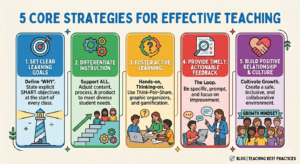
(Wait! Need a visual guide? Scroll to the bottom of this post for our handy infographic summarizing these key strategies.)
1. The Foundation: Set Clear Learning Goals (The ‘Why’)
Effective teaching begins before you ever say a word in front of the class. It starts with intentionality. Every lesson should have a visible and articulated “destination.”
Research shows that when students understand the learning intentions of a lesson and know the exact path to success, their engagement and performance significantly increase.
How to implement:
-
Write it down: Start every class by clearly displaying the SMART learning objectives (Specific, Measurable, Achievable, Relevant, Time-bound). Example: “By the end of this period, we will be able to explain the three types of natural selection.”
-
Check in frequently: Refer back to these goals throughout the lesson to keep everyone on track.
2. Differentiate Instruction (Support All Students)
No two students walk into your classroom with the exact same background knowledge, learning style, or confidence level. Differentiated instruction isn’t about creating 30 different lesson plans; it’s about proactively planning for varying student needs, strengths, and preferences.
Differentiating allows you to adjust the content, process, and product to meet your students where they are, ensuring everyone has an equitable opportunity to succeed.
How to implement:
-
Tiered assignments: Offer different versions of the same assignment (with varying complexity or support) depending on a student’s current proficiency.
-
Flexible grouping: Mix up small groups based on ability, interest, or specific skills needed.
-
Choice boards: Give students a menu of options for how they will learn or demonstrate mastery of a topic.
3. Move from Lecture to Active Learning (Hands-on, Thinking-on)
We know that true understanding isn’t just about passive listening; it’s about active engagement. Active learning requires students to construct their own knowledge by doing things—thinking critically, solving problems, and collaborating. It’s the process of transforming a passive observer into an active participant.
How to implement:
-
Think-Pair-Share: Pose a difficult question, give individuals a minute to think, then have them pair up to discuss, and finally share with the whole class.
-
Graphic Organizers: Use Venn diagrams, mind maps, or KWL (Know, Want to Know, Learned) charts to help students visualize and organize information.
-
Gamification: Turn a review session into a friendly competition using digital tools or in-class games.
4. Provide Specific, Actionable, and Timely Feedback
Feedback is perhaps the single most powerful tool an educator has. But “good job” isn’t feedback. To be effective, feedback must be a prompt, precise, and practical diagnostic tool that allows a student to understand where they are and, specifically, how to improve.
Effective feedback doesn’t just evaluate the final product; it engages in a continuous loop that addresses misunderstanding immediately.
How to implement:
-
Target the task, not the person: Instead of “You’re bad at this,” say, “In your thesis statement, you need to state a clear argument that can be defended.”
-
Use formative assessments: Use quick checks, like exit tickets or thumbs-up/thumbs-down, during a lesson to gather real-time data and adjust instruction on the fly.
5. Cultivate a Supportive and Inclusive Environment (The Climate for Growth)
Finally, none of these strategies will reach their full potential if your classroom isn’t a safe space where students feel valued, respected, and willing to take intellectual risks. A positive class culture is not the “soft stuff”; it’s the non-negotiable prerequisite for all other learning. Addressing the fear of failure is a key component of this.
How to implement:
-
Build rapport: Get to know your students as individuals and celebrate their unique perspectives.
-
Foster collaboration: Use structured cooperative learning structures where every student has a defined role.
-
Nurture metacognition: Encourage self-reflection and prompt students to ask, “How am I thinking about this subject?”